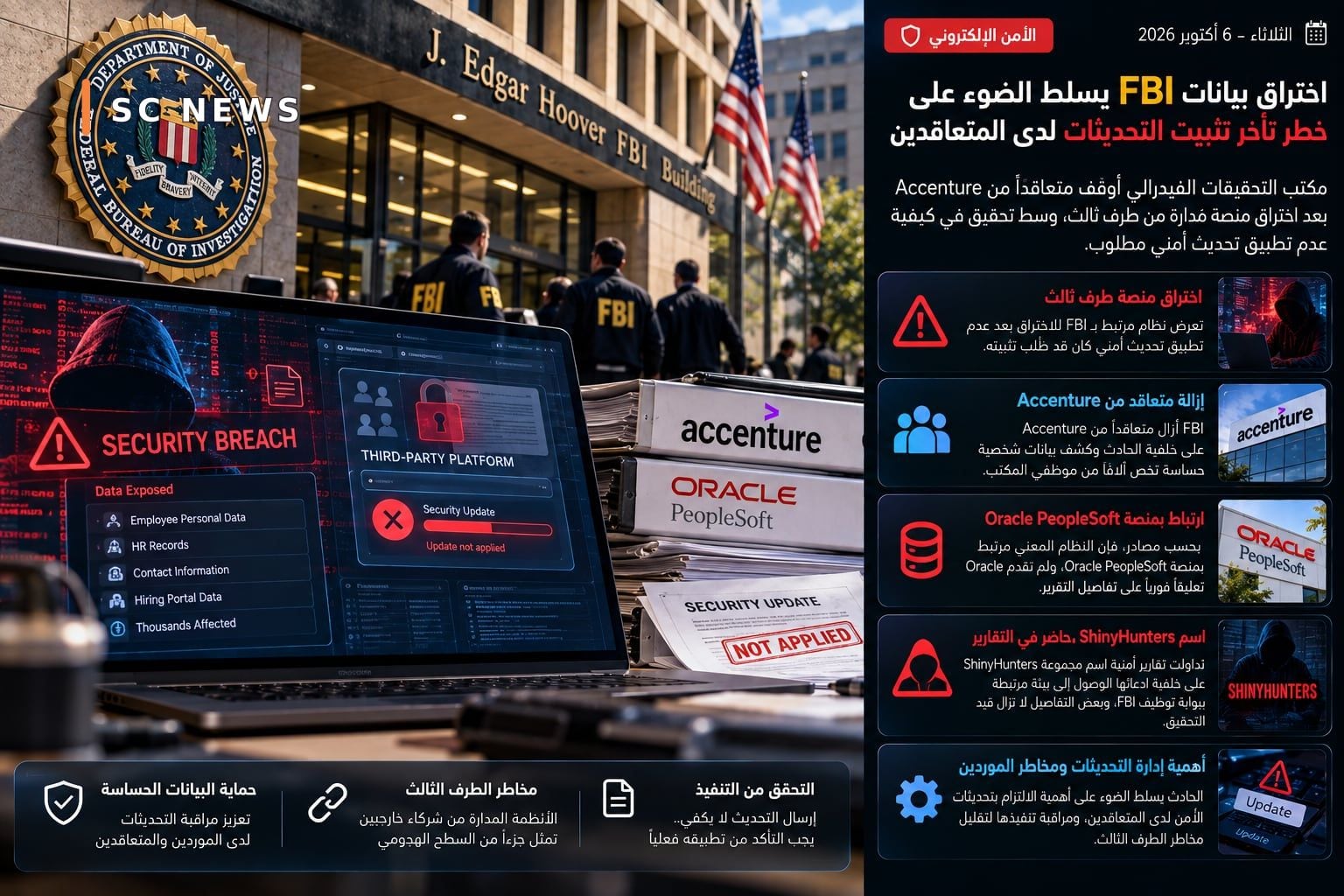
A security breach that hit a system linked to the US Federal Bureau of Investigation (FBI) brought the security update management file for suppliers and contractors back to the forefront, after officials revealed that a platform managed by a third party had been compromised after a security update that had been requested to be installed was not implemented.
Reuters reported in a report published today that the FBI removed a contractor from Accenture following the incident, which led to the exposure of sensitive personal data belonging to thousands of office employees.
A senior FBI official said, according to the report, that the problem was related to a failure within a platform managed by a third party after a security update was not implemented. Issuing it explicitly.
According to sources who spoke to Reuters, the system in question is linked to the Oracle PeopleSoft platform, while Accenture was among the entities providing services related to the affected environment. Oracle did not provide immediate comment on the details of the report at the time of publication.
Security reports circulated the name The ShinyHunters group allegedly accessed an environment linked to the FBI recruitment portal over the past month, but some details of the hacking path are still based on statements attributed to the attackers and journalistic sources, and therefore not all technical allegations circulating should be treated as Final results of the investigation.
The significance of the incident extends beyond the affected institution itself. In large corporations and government agencies, enterprise systems may be distributed among internal teams, consulting firms, software vendors, and managed services. The greater the number of parties, the more limited the liability Installing updates and keeping track of security alerts is more complicated.
Having a security update does not mean that the problem is gone. You must first identify vulnerable systems, test the update, schedule its deployment, confirm its success, and then monitor the environment after implementation. Any gap between these steps may leave the system At risk even if technical processing is already available.
Here the concept of third-party risks clearly appears. An organization can have a strong security team, but a service managed by an outside contractor remains part of its attack surface. Modern corporate security policies are therefore demanding Vendors with clear records of updates, specific timelines for remediating critical vulnerabilities, and proof that the change was actually implemented.
The incident also holds a lesson regarding monitoring compliance. Sending instructions to the contractor is not a substitute for technical verification of their implementation. Sensitive systems need To centralized tools that can show the status of updates, and raise an alert when a vulnerable system remains untreated.
For government agencies, the issue becomes more sensitive due to the nature of the data that may be contained in human resources, recruitment, or internal services systems. until A system that does not contain confidential operational information may contain personal data that is valuable to attackers.
The FBI said it was working on containment and assessment, while Accenture said in its response that it was proud to support the office, according to Reuters. A final investigation result that defines all stages of the incident has not yet been announced and responsibilities in detail.