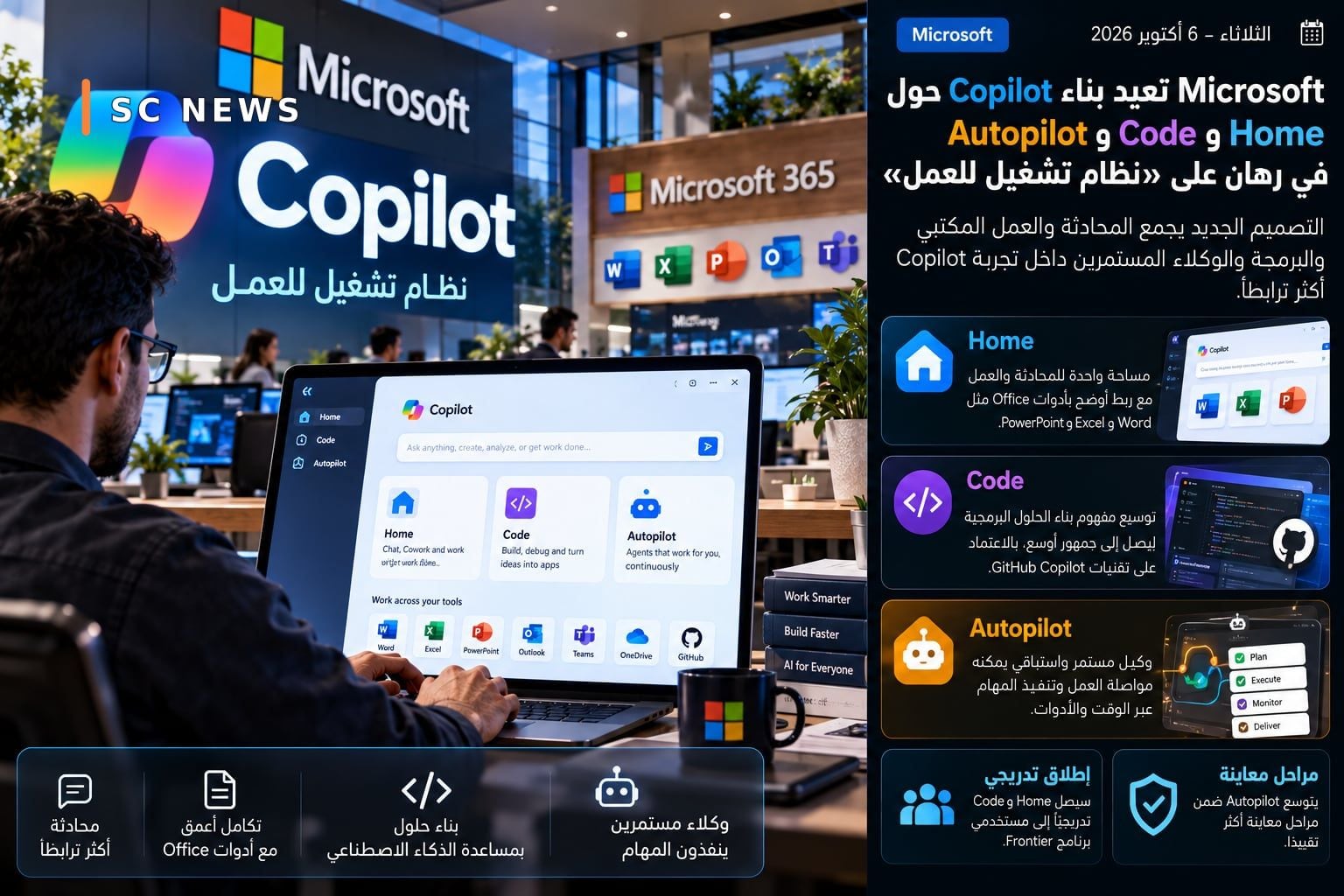
Microsoft is pushing the Copilot platform beyond the model of an assistant waiting for a user question, after introducing a redesigned experience based on three main spaces: Home, Code and Autopilot.
The announcement, released on September 25, marks a significant change in Microsoft's perception of the product. Instead of being Copilot is a group of assistants distributed across different applications. The company is trying to build a central point of work that can move between chat, documents, programming, and autonomous agents without leaving the environment itself.
In Home, Microsoft combines Chat and Cowork, with a clearer connection to Office tools. The idea is to start The user has one space whether he wants to discuss a task with Copilot or work on Word, Excel and PowerPoint files.
As for Code, it aims to expand the concept of building software solutions to an audience beyond traditional developers. Microsoft says this experience relies on technologies related to what it developed on GitHub Copilot, but presented in a way that allows users within companies to transform needs and ideas into practical tools or solutions of varying degrees of complexity.
The most ambitious section is Autopilot, which Microsoft describes as a persistent, proactive agent that can keep working instead of just being attached to In a real-time chat session.
This shift is important because the first generation of AI assistants was essentially request-and-response-based: a user types a question, gets a result, then initiates a new request. The continuous agent model attempts to maintain a larger goal and pursue it over time And tools.
Microsoft said Home and Code will gradually reach Frontier users, while Autopilot is expanding in more restricted preview phases. This means that the redesign is not an immediate, uniform rollout for all Copilot customers, but rather a gradual rollout.
The Verge describes the broader trend as an attempt To make Copilot more of a workflow layer, where tools, files, agents, and conversations become parts of a single space instead of being treated as separate applications.
This trend is especially important for Microsoft 365 customers. The company already owns mail, meetings, documents, and schedules Presentations, institutional files and development platforms. If Copilot can work across this ecosystem in a unified manner, the value of the product will not be in the quality of the AI model alone, but in its ability to understand the context within everyday business tools.
But this also raises the bar Challenges. An agent that can perform multiple steps needs clear permissions, an auditable log, and controls that prevent unintended changes, especially within enterprise environments.
Organizations will also need to evaluate the difference between helping to draft a document and granting a proxy Programmatic or administrative ability to continue performing tasks for an extended period.