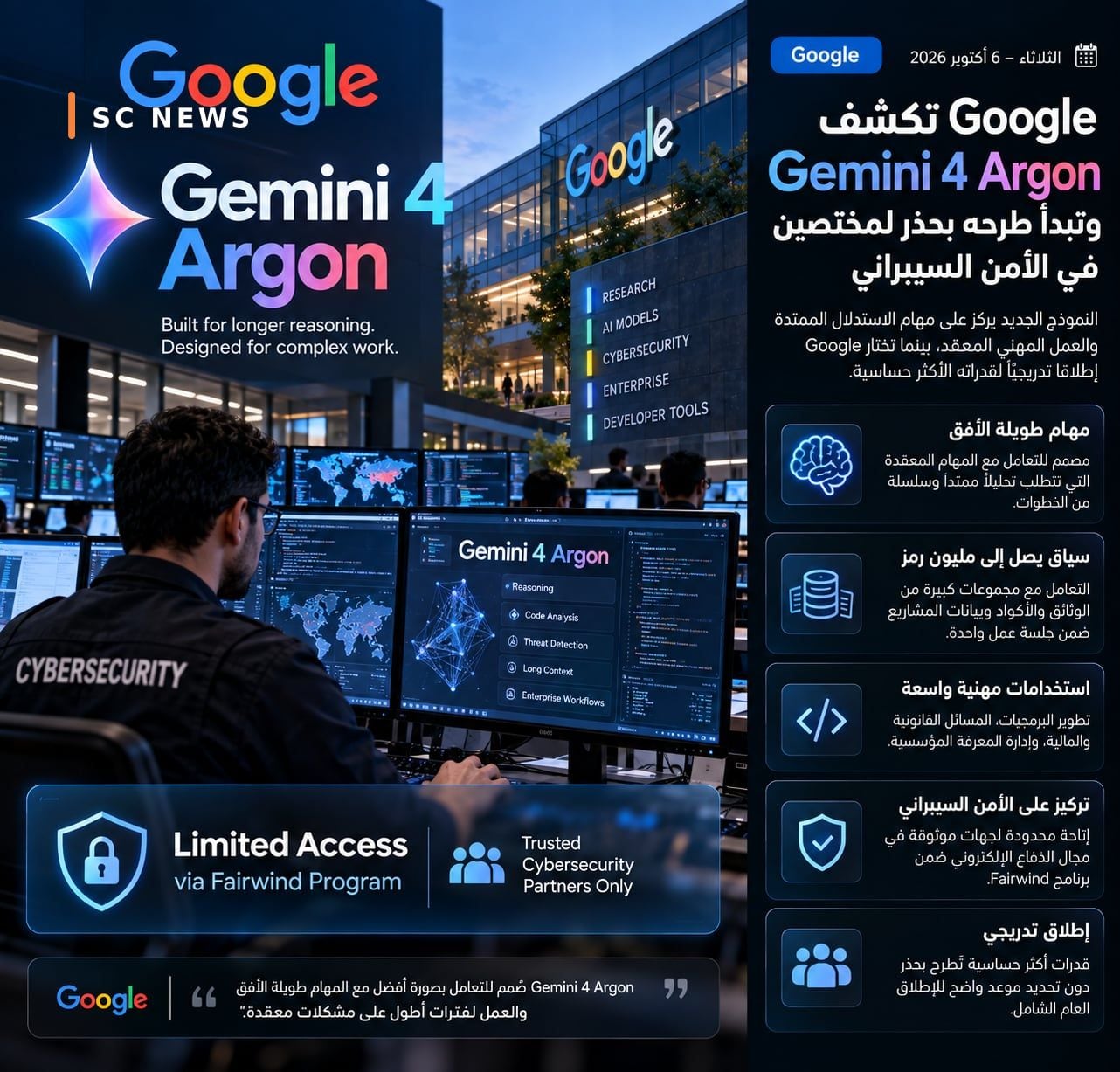
Google has unveiled Gemini 4 Argon, its latest flagship model in the Gemini family, with a clear focus on tasks that require extended inference and longer work on complex issues, such as software engineering, enterprise cognitive work, and some cyber defense tasks.
Announcement Issued on 30 September, until October 6, is Google's latest major announcement related to its new generation of artificial intelligence models. However, the company did not treat Argon as a traditional update that is immediately available to all users. Some of its capabilities are being accessed in a limited way, especially by specialized entities in cybersecurity.
Google says that the Gemini 4 Argon is designed to better handle long-range tasks, that is, those that do not end with a short question and answer, but require analyzing a large amount of information, retaining context, taking a series of steps, and then reviewing the results before reaching Final exit.
The company also announced a context of up to one million codes, which allows the model to handle large sets of documents, codes, or project data within the same session. Google links this capability to professional uses including software development, legal issues finance, and institutional knowledge management.
The most striking is the cybersecurity dossier. Instead of opening up all capabilities directly to the public, Google began making Argon available to trusted cyber defense actors as part of the Fairwind program, the company announced.
This policy reflects the sensitivity of Increasingly within the AI sector towards models capable of carrying out advanced technical work. A capability that helps a security team analyze a huge system or detect vulnerabilities can, in different circumstances, become dual-use.
This is why the method of launching is equally important about the specification of the model itself. Google is not only talking about increasing Gemini's capabilities, but is also testing a more gradual model in the distribution of access to sensitive capabilities.
The announcement came after months of delay, Reuters said, and when the model was unveiled, Google did not give a clear date for a public launch. All-encompassing, while beginning to be used by a select group of cybersecurity partners.
For developers and businesses, Argon opens the door to a different type of AI tool. Competition is no longer limited to the speed of text generation or the quality of short answers; value The highest is in the model's ability to understand large code repositories, analyze extended institutional files, and continue a complex task across multiple stages.
In contrast, the question of cost, speed, and actual availability will remain important before judging the impact of the model commercially. Performance in Initial tests and announcements alone are not enough; organizations need to know how to integrate it into workflows, security controls, and how to handle sensitive data.