Companies in the Egyptian market face increasing challenges related to competition, changing consumer behavior, high costs of attracting customers, and multiple marketing channels. In light of these challenges, building marketing strategies for companies has become an essential necessity to achieve growth and enhance capabilities Competitiveness and investing budgets more efficiently.
Marketing success does not depend only on launching advertising campaigns or publishing content via social media, but rather it begins with developing an integrated strategy that defines the company’s position in the market, the audience it targets, the value it provides, and the appropriate channels to reach it. Customers, and the way in which interest can be converted into actual sales and contracts.
Select Customers Marketing, known as SC Marketing, provides the service of building marketing strategies for companies through customized solutions based on studying business activity, analyzing competitors, understanding customers, identifying growth opportunities, and developing a clear marketing path that suits the goals of each customer. Institution and its budget.
Through its experience since 2018 in digital marketing, advertising, programming, and developing digital solutions, the company is interested in linking marketing decisions to actual commercial goals, which helps institutions develop their presence in the Egyptian market and prepare for expansion in the targeted markets. The other.
What is meant by building marketing strategies for companies?
Building a marketing strategy is an analytical and planning process that aims to determine how a company can compete within the market, reach the right customers, and provide clear value that distinguishes its products or services from available alternatives.
The marketing strategy includes studying the competitive environment, dividing the audience into segments, identifying target markets, building the identity and mental position of the brand, choosing marketing channels, determining marketing investment priorities, and developing indicators to measure performance.
The strategy is not limited to achieving short-term sales, but also aims to build ongoing relationships with customers, enhance trust, improve the ability to retain existing customers, and create opportunities for sustainable growth.
The successful strategy varies from one company to another, because the nature of the product, the size of the market, the intensity of competition, the available resources, and the purchase decision-making cycle are all factors that affect the choice of the appropriate marketing direction.
Therefore, a professional marketing strategy cannot be a fixed model applied to all activities, but rather it must start from a careful study of the commercial reality of each company.
The importance of building a professional marketing strategy for companies in Egypt
The Egyptian market has a great diversity of commercial, industrial and service activities, in addition to differences in purchasing behavior between regions and target groups.
Companies may face challenges related to customer sensitivity to prices, intensity of competition, difficulty in differentiation, or lack of clarity in the returns from advertising activities.
Here the importance of building an integrated marketing strategy appears that helps management make more accurate decisions.
Determine the company's marketing direction
The strategy helps determine the position the company wants to reach, the segments it can serve efficiently, and the competitive advantage worth focusing on.
Instead of targeting all customers with generic messages, the company is able to identify the markets and segments that are most relevant to what it offers.
Improving the investment of marketing budgets
Strategic planning helps direct resources to activities and channels that have a better chance of achieving goals, according to available data and practical tests.
It also reduces reliance on random decisions and campaigns not linked to clear commercial objectives.
Enhancing competitiveness
Studying the market and competitors helps discover marketing gaps and opportunities that the company can invest.
These opportunities may include providing a more specialized service, improving the customer experience, developing a value proposition, or targeting a segment that does not receive sufficient attention from competitors.
Increase the chances of attracting potential customers
When the marketing message is consistent with the audience's needs, and is presented through the appropriate channels, the chances of attracting customers who have an actual interest in the products or services increase.
The strategy also helps improve the quality of inquiries and requests rather than focusing solely on increasing their numbers.
Building a strong brand
Consistency between visual identity, marketing messages, and customer experience contributes to building a clear image of the company in the minds of the audience.
Over time, this consistency can support brand trust and help customers differentiate it from competitors.
Support growth and expansion
The strategy provides a framework that helps the company evaluate opportunities to provide new services, enter different sectors, or expand geographically inside and outside Egypt.
What is the difference between marketing strategy and marketing plan?
Despite the close connection between the two terms, there are important differences between building a marketing strategy and preparing a marketing plan.
The marketing strategy determines the direction the company will follow to achieve its goals, and answers basic questions such as: Who are the target customers? Why do they choose the company? What distinguishes it? Where should you compete? How can it achieve growth?
The marketing plan is the executive framework that transforms the strategy into clear activities, including advertising campaigns, content, timelines, budgets, responsibilities, and performance indicators.
For example, a company that specializes in supplying industrial products may adopt a strategy based on targeting factories and contracting companies that need reliable suppliers.
This strategy is translated into a plan that includes developing service pages, producing specialized technical content, improving appearance in search results, running campaigns targeting procurement officials, and establishing an organized mechanism to follow up on requests for quotations.
Thus, the strategy defines what must be achieved and how the company will compete, while the plan defines the activities necessary to implement this direction.
Stages of building marketing strategies for companies
The process of developing a successful marketing strategy requires going through interconnected stages, starting with understanding the business and ending with establishing a clear system for implementation, measurement and improvement.
Study the business activity and analyze the current situation
The process of building a strategy begins with understanding the company's business model and the nature of the products or services it provides.
The study includes identifying revenue sources, current customer segments, competitive advantages, pricing policies, sales channels, and available human and technical resources.
Previous marketing activities, the website, social media pages, and available data on campaigns and sales are also reviewed.
This stage helps to identify the real problems that hinder growth, whether they are related to poor customer outreach, low conversion rates, lack of clarity in the marketing message, or insufficient follow-up processes.
Analysis of the Egyptian market and study of competitors
Market analysis represents one of the most important elements of building marketing strategies, because it explains the conditions within which the company operates and the opportunities and challenges that can affect its results.
This stage includes studying the volume of demand and its trends as much as available data allows, the nature of competition, economic factors affecting purchasing decisions, and the difference in customer needs between geographical regions.
Direct and indirect competitors are also studied in terms of products and services, marketing messages, announced price levels, channels used, and apparent customer experience.
In the Egyptian market, consumer priorities may differ between Cairo, Giza, Alexandria and other governorates, according to the nature of activity, level of income, availability of alternatives and means of distribution.
Therefore, the local strategy must be based on actual audience analysis, rather than assuming that all Egyptian customers have the same needs or purchasing behavior.
SWOT analysis and competitive positioning
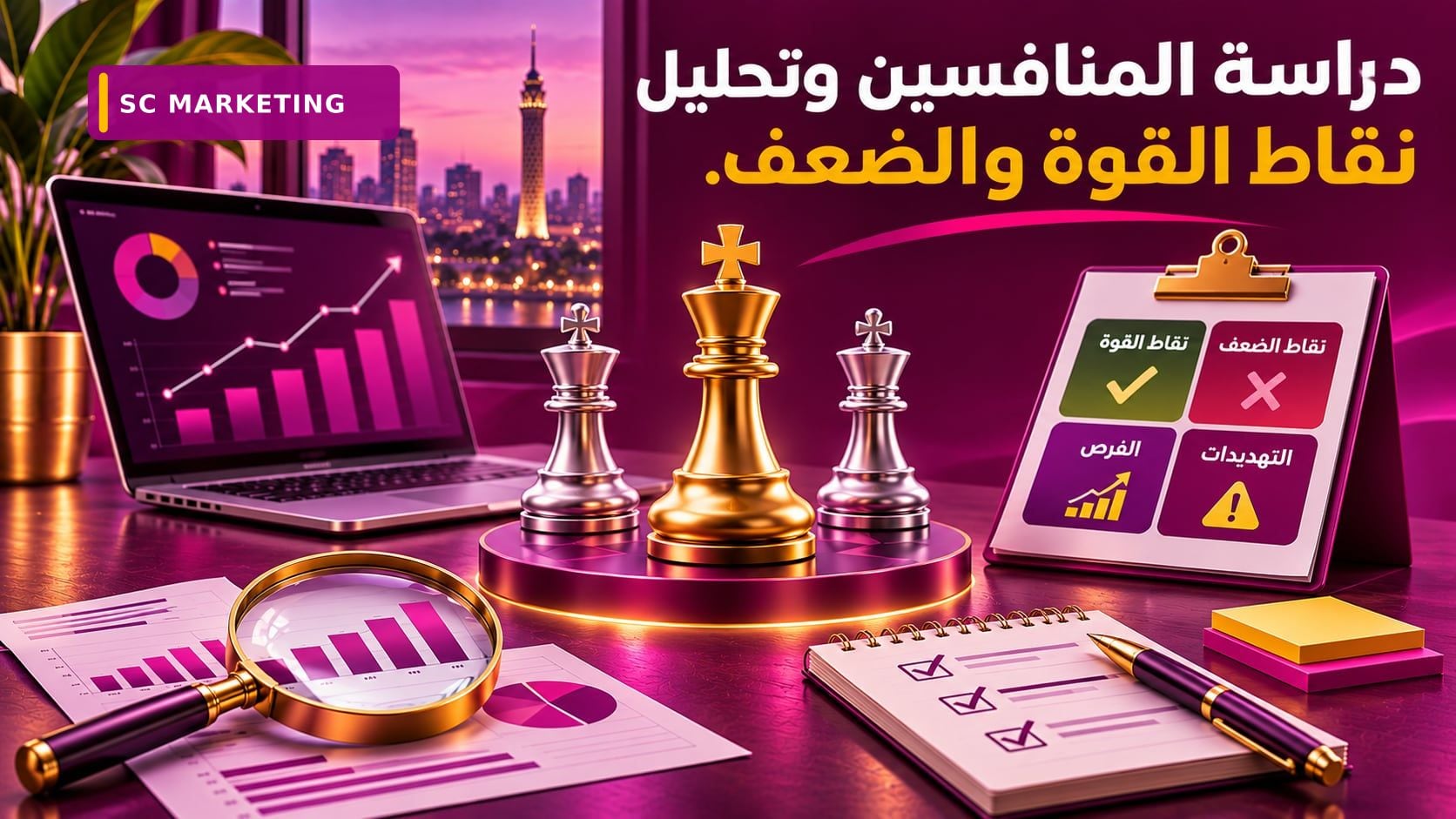
SWOT analysis helps to understand the strategic position of the company.
Strengths include internal factors that give an organization an advantage, such as product quality, specialization, or customer service.
Weak points may be related to limited outreach, insufficient marketing content, weak digital infrastructure, or insufficient sales processes.
Opportunities relate to changes that a company can take advantage of, while threats include intense competition, fluctuating costs, or changing customer needs.
The importance of this analysis does not stop at recording observations, but rather extends to transforming its results into practical decisions that help determine priorities.
Segmenting the market and determining the target audience
Not all groups are equally likely to purchase a company's products or benefit from its services.
This is why the strategy relies on dividing the market into groups that are similar in their needs, characteristics, or purchasing behavior.
Segmentation may be geographic, demographic, or behavioral, or based on type of activity and size of organization in the case of business-to-business marketing.
Next comes the stage of selecting target segments, based on the size of the opportunity and its suitability to the company’s capabilities and potential profitability.
Buyer Personas models can also be developed to understand purchasing motives, the problems for which the customer is looking for solutions, and the factors that influence decision-making.
This information helps develop marketing messages that are more relevant to customer needs rather than just general messages.
Determine competitive advantage and value proposition
Determining the value the company offers is one of the most important steps when building a marketing strategy.
It is not enough for the organization to provide good products or professional services, but it must be able to explain the reasons that lead the customer to choose it over others.
The value provided may be related to the quality of implementation, specialization, speed of supply, after-sales service, flexibility, or cost-effectiveness of what the customer gets.
This value is known as Value Proposition, and it is the basis on which marketing messages and commercial offers are built.
It is important that the stated benefits are real and can be backed up, because over-promising may negatively affect customer confidence.
Building the brand's mental position
Brand Positioning refers to the image that the company wants to establish among the public compared to competitors.
One company may seek to be the specialist in high quality, while another focuses on economic solutions, ease of use, or speed of service delivery.
This positioning must be reflected in the communication style, visual identity, product presentation, pricing, and customer experience.
It must also be compatible with the company's real capabilities, so that a gap does not arise between the marketing image and the actual experience.
Determine marketing objectives
After analyzing the market, audience and competition, clear objectives are defined that are directly linked to business priorities.
Objectives may include increasing sales, acquiring new customers, increasing the value of orders, improving customer retention, or expanding into new geographic areas.
It is preferable to formulate goals according to the SMART approach, so that they are specific, measurable, achievable, linked to activity, and time-bound.
For example, instead of setting a general goal such as increasing customers, you can set a goal to increase the number of qualified inquiries over a certain period, provided that the goal is based on historical data, budget, and operational capacity.
Choosing the appropriate marketing channels
Choosing channels comes after defining the audience, goals and competitive advantage, not before.
Appropriate channels vary depending on the nature of the business and the purchasing decision cycle.
Google search ads may be suitable for services that customers are searching for when there is an immediate need, while social media platforms help to present products visually and build engagement and brand awareness.
Other methods, such as content marketing, search engine optimization, email marketing, or B2B marketing, may be more appropriate for certain activities.
In building the marketing concept, SC Marketing relies on studying how to integrate these channels, rather than relying on one platform automatically.
Customer journey design and conversion funnel optimization
The customer's relationship with the company goes through several stages, starting with getting to know the brand, then being interested in what it offers, then comparing and evaluating, all the way to making a purchase or contracting decision.
These stages are known as the Customer Journey.
Each stage requires an appropriate message and marketing tool.
In the awareness stage, introductory and educational content may be an appropriate way to attract attention.
In the evaluation phase, the client may need to see specifications, business models, pricing details, or answers to frequently asked questions.
In the decision-making stage, the importance of clarity of the offer, ease of communication, speed of response, and the presence of specific steps to request the service or complete the purchase are highlighted.
Studying the customer journey helps discover leakage points that may cause lost sales opportunities, and develop a more seamless experience between the ad, website, and sales team.
Building a digital marketing strategy for companies
Digital marketing represents an important element in modern strategies, but it requires integration between several activities to achieve the best possible benefit.
Social media marketing strategy
It focuses on determining the appropriate platforms for the audience, the nature of the content, the communication style, and the goals to be achieved from each channel.
It may include Facebook, Instagram, TikTok, YouTube, and LinkedIn, depending on the target audience and the nature of the activity.
The role of social media is not limited to increasing followers, but it can be used to build trust, display products and services, support campaigns, and direct customers to communication and purchasing channels.
Sponsored advertising campaign strategy
It depends on defining advertising objectives, target segments, creative messages, and budgets.
It also includes developing a methodology for testing campaigns and monitoring and developing results.
It is important to distinguish between campaigns designed to raise awareness and those aimed at attracting inquiries or generating sales, because their indicators of success differ.
SEO strategy
It aims to increase the chances of customers reaching the company through search results related to the products or services it provides.
It includes studying keywords, analyzing search intentions, improving service pages, preparing specialized content, and developing the technical aspects of the website.
This strategy is suitable for activities whose customers search for specific solutions through search engines, while taking into account the level of competition and the period required for results to appear.
Content marketing strategy
Determines the type of information and messages that customers need during the decision-making stages.
They may include articles, videos, designs, case studies, educational content, and demonstrations of products and services.
Content strategy helps deliver real value to the audience, build credibility, and support search results and advertising campaigns.
Customer retention strategy
Growth does not stop at attracting a new customer, but rather includes developing a relationship with him and increasing the likelihood that he will continue doing business with the company.
The strategy may include improving after-sales communication, organizing follow-up, providing suitable offers to existing customers, measuring the level of satisfaction, and analyzing the reasons why some customers stop buying.
The appropriate method varies depending on the nature of the activity and the frequency of purchasing the product or service.
Building marketing strategies for B2B companies in Egypt
Business-to-business strategies are different from strategies targeting the end consumer.
In B2B marketing, the buying journey may involve several people responsible for evaluation, budgeting, and final approval.
Negotiations may also take longer and require technical and financial offers and direct communication before contracting.
Therefore, B2B strategy is concerned with identifying target sectors, understanding the needs of decision-makers, and building messages that focus on commercial value, expected return, and quality of solutions.
Suitable channels may include optimizing specialized services pages, search engine marketing, preparing documented case studies, structured business communication, and targeted digital campaigns.
The strategy also helps establish criteria for evaluating potential customers, so the sales team can prioritize the most suitable opportunities.
Marketing strategies for factories and industrial companies
Industrial companies in Egypt need marketing solutions that are compatible with the nature of their products and methods of purchasing and supply within the targeted sectors.
Objectives may include reaching new distributors, increasing requests for quotes, enhancing plant confidence, or entering additional industry sectors.
The strategy is based on analyzing products, technical specifications, production capabilities, supply conditions, and competition.
You can also focus on developing a professional website that clearly displays products, producing artistic content, improving search visibility, and facilitating communication with sales teams.
In this type of activity, the quality of business inquiries may be more important than the high number of visits or general interactions.
Building marketing strategies for electronic stores
The strategy of online stores depends on understanding the relationship between attracting visitors, converting them into buyers, increasing the value of the order, and retaining customers.
It includes studying the most profitable products and categories, analyzing traffic sources, reviewing the user experience, evaluating product pages, and studying the reasons for shopping cart abandonment.
Strategies can also be developed to retarget, improve offers, and distribute budgets between attracting new customers and motivating existing customers to repeat purchases.
Expansion decisions should be based on indicators including customer acquisition cost, profit margin, average order value, and conversion rate.
An increase in revenue does not necessarily mean improved profitability if advertising and implementation costs increase further.
Building marketing strategies for service companies
Service companies rely heavily on credibility, experience, and clarity of the results that the customer expects to obtain.
This is why the strategy is concerned with identifying the problems that the service addresses, clarifying the stages of work, highlighting the factors of distinction, and building content that helps the customer understand the solution before requesting it.
The strategy may include developing customized service pages, improving communications, preparing campaigns to attract potential customers, and coordinating work between marketing and sales.
It also takes into account the length of the contracting cycle, the different degree of readiness of clients to make a decision, and the need for organized follow-up of inquiries.
This approach is suitable for contracting, engineering, professional services, education, technology and other activities that need to build trust before completing the contract.
Pricing and promotional strategy
Pricing represents an essential element in building a marketing strategy, because it affects the company's image, profitability, and ability to compete.
Reducing prices should not be the only way to attract customers.
The company may rely on providing additional value, developing various packages, improving the purchasing experience, or providing benefits that suit the needs of specific segments.
The pricing strategy requires studying costs, profit margins, the value perceived by the customer, available competitive prices, and the extent of the market’s sensitivity to price changes.
Promotions should also be designed to support business objectives without diluting brand value or unduly affecting profits.
Distribute the marketing budget according to priorities
One of the most prominent features of a professional marketing strategy is that it helps determine where the budget should be invested, and what activities deserve priority.
This begins with understanding the amount of resources available and the costs required to reach goals.
The budget may be divided into content production, sponsored campaigns, search engine optimization, website development, analytics tools, and other marketing activities.
There is no uniform budget distribution ratio that is suitable for all companies.
A new project may need to invest more in brand recognition and channel testing, while an existing company may prioritize improving conversions, retaining customers, or expanding into new segments.
It is also best to allocate adequate resources for testing and improvement, so that the strategy remains scalable as new data emerges.
Indicators for measuring the success of the marketing strategy
Each strategy should have a clear system for evaluating results, selecting indicators that align with the company's goals and business model.
The most important indicators that can be used are:
Customer Acquisition Cost (CAC), which is the cost associated with obtaining a new customer according to a specific calculation method.
Customer lifetime value (LTV), which is an estimate of the economic value a customer can achieve during their relationship with a company.
Conversion Rate, which shows the percentage of users who perform a targeted action.
Return on Advertising Spend (ROAS), which compares the revenue attributable to advertising with the advertising cost according to the measurement system used.
Cost per lead (CPL), which helps evaluate the cost of obtaining inquiries or business opportunities.
Customer Retention Rate, which reflects the ability of the business to continue the relationship with its customers during a specific period.
The importance of these indicators varies depending on the nature of the company.
Focusing on the cost of acquiring a lead may be appropriate for an engineering services company, while conversion rate and average order value are important indicators for an online store.
It is important to interpret the numbers in their commercial context, and not consider the low cost of advertising alone as evidence of the success of the strategy.
Common mistakes when building marketing strategies
One of the most common mistakes companies make is to start running ads before identifying the target audience and competitive value.
Some organizations also rely on imitating competitors' campaigns without understanding the reasons for their success or their suitability to their activity.
Other mistakes include focusing on the number of followers rather than the quality of customers, targeting too broad segments, or ignoring sales and customer service data when making marketing decisions.
Expanding into a large number of channels without sufficient resources may lead to budget fragmentation and poor implementation quality.
Also, constantly changing the marketing orientation before collecting appropriate data makes evaluating the results more difficult.
Avoiding these mistakes requires clear goals, testable assumptions, defined responsibilities, and a monitoring system that helps make decisions based on evidence.
When does your company need to rebuild its marketing strategy?
The company may need to develop its strategy when market conditions change or the effectiveness of the methods used declines.
Signs that require re-evaluation include low quality of leads, high acquisition costs, declining conversion rates, or lack of clarity about why customers choose competitors.
Rebuilding may also be necessary when launching new products, targeting different segments, changing the business model, or planning to expand to other governorates or countries.
Rebuilding the strategy does not necessarily mean changing all current activities, but rather it may include retaining successful elements and developing parts that do not achieve the desired results.
How do you choose a company specialized in building marketing strategies?
When choosing a marketing strategy company in Egypt, it is important to evaluate its ability to understand the business, and not just review the advertising services it provides.
It is preferable for the company to be able to analyze the market and competitors, identify the target audience, understand the relationship between marketing and sales, and set measurable goals.
The service deliverables must also be clear, whether it is a market study, a strategy document, a channel and budget visualization, or an implementation roadmap.
It is also important to know whether the service includes strategy preparation only, or whether it includes implementation management, follow-up, and development.
Defining these details before contracting helps clarify responsibilities and costs and ensure alignment of expectations between both parties.
How much does it cost to build a marketing strategy for companies in Egypt?
Prices for building marketing strategies for companies vary according to a group of factors, the most important of which are the size of the organization, the nature of its activity, the number of products and services, the level of competition, the target markets, and the availability of the data required for analysis.
The cost is also affected by the depth of study of the market and competitors, the number of audience segments, the size of the marketing channels to be evaluated, and the level of detail required in the final outputs.
For example, the requirements for building a marketing strategy for a startup company operating within one governorate differ from the requirements for an industrial company targeting several commercial sectors within Egypt and planning external expansion.
It is also necessary to distinguish between the costs of building the strategy and the costs of implementing it.
The consulting service may include analyzing activity, developing strategic direction, identifying audiences and channels, and providing practical recommendations.
Implementing advertising campaigns, designing content, managing platforms, and developing websites may represent additional services according to the agreement.
SC Marketing offers customized marketing solutions at competitive prices, taking into account each company's objectives, project requirements and desired scope of business.
The price offer can be determined more accurately after studying the business activity and clarifying the nature of the outputs and services that the customer needs.
Building a marketing strategy for startups
Startups need to define a clear position within the market before expanding marketing spend.
At this stage, the strategy focuses on ascertaining audience needs, identifying the groups most likely to purchase, formulating a clear value proposition, and testing appropriate channels with thoughtful budgets.
It also helps to identify recurring objections from customers, develop marketing messages, and improve the way the product or service is presented.
It is not necessary for a startup to start with a complex strategy or a high budget, but it is important to have a logical vision that can be tested and developed according to the results.
Building a marketing strategy for medium and large companies
Medium and large companies need to deal with different challenges than startups.
These challenges may include multiple product lines, different customer segments, the presence of multiple sales teams, and the need to unify marketing messages between departments.
Therefore, the strategy may include organizing the brand structure, determining market priorities, establishing policies for distributing budgets, and developing coordination mechanisms between marketing, sales, and customer service teams.
Analyzing profitability, customer quality and retention also becomes more important when evaluating decisions about expansion and growth.
Building marketing strategies for Arab markets
Despite the focus on the Egyptian market, some companies may need a strategy that helps them reach customers outside Egypt.
Select Customers Marketing services target companies operating or planning to market in Egypt, Saudi Arabia, the Emirates, Jordan, Iraq, Oman, Kuwait, Qatar and Sudan.
Expansion between markets requires an independent study of customer needs, competition, available channels, cultural and linguistic factors, and requirements related to the activity.
The success of a marketing message within the Egyptian market does not necessarily mean achieving the same results when used in another market without modification.
Therefore, the expansion strategy must be based on analyzing each market and identifying opportunities that match the company's capabilities and its products or services.
Why choose SC Marketing to build your company's marketing strategy?
The process of building effective marketing strategies is characterized by the need for an interconnected understanding of the market, advertising, content, technology and customer experience.
Since 2018, Select Customers Marketing has been working in the fields of advertising, digital marketing, programming, and digital solutions development, which gives it a multidisciplinary background when examining the needs of business projects.
The company focuses on developing solutions that suit the nature of the business rather than relying on a single marketing approach for all clients.
It is also concerned with linking the strategy to growth goals, identifying channels that can serve these goals, and clarifying the role of content, advertising campaigns, and the website in the customer journey.
Among the elements that the company pays attention to when providing its services is understanding the challenges of each project, setting priorities, and building a practical vision that helps organize marketing decisions and improve the use of resources.
Attention to detail, quality of output, customized solutions, and competitive pricing are some of the aspects that the company seeks to provide to its clients.
The primary goal is to help companies have a clear marketing direction that can be transformed into actionable activities, monitoring and development.
Frequently asked questions about building marketing strategies for companies
What is the best marketing strategy for companies in Egypt?
There is no one-size-fits-all strategy for all companies. The choice depends on the nature of the activity, target audience, competitive advantage, budget, and business goals. The appropriate strategy begins with analyzing these elements before identifying channels and activities.
What is the difference between building a marketing strategy and marketing management?
Strategy building focuses on defining direction, objectives, audience, positioning, channels and investment priorities. Marketing management includes implementing daily activities, following up on campaigns and content, analyzing results, and managing work teams.
Do small businesses need a marketing strategy?
Yes, because the strategy helps set priorities and direct limited resources to activities that are best suited to the project objectives, rather than allocating the budget without consideration.
Is it possible to build a marketing strategy for a new company?
Yes, you can initially rely on market research, competitor analysis, customer interviews, and preliminary tests. The strategy is developed with real data on audience behavior and sales.
How long does it take to build a marketing strategy?
The duration varies according to the volume of activity, the number of products and markets, the level of analysis required, and the availability of data. The timetable is determined after agreeing on the scope of the study and the required outputs.
Does the marketing strategy include advertising campaigns?
The strategy usually includes defining the role of sponsored advertising within marketing channels, while implementing and managing campaigns depends on the scope of the contract.
Does the marketing strategy guarantee increased sales?
No strategy can guarantee specific selling results, because performance is affected by multiple factors including product quality, pricing, competition, execution and customer experience. But it helps improve the quality of decisions and build a system to measure and develop results.
Is it possible to build a marketing strategy without relying on sponsored ads?
Yes, some activities may depend on search engine optimization, specialized content, direct marketing, partnerships, and customer retention. The appropriate mix is determined according to the audience, objectives and available resources.
What is the importance of analyzing competitors before building a strategy?
Competitor analysis helps to understand the alternatives available to customers, identify points of distinction and market opportunities, choose the appropriate positioning, and avoid entering into ill-considered competition.
Is a B2B strategy different from a B2C strategy?
Yes, because B2B marketing is often associated with longer selling cycles and purchasing decisions involving multiple parties, while the motivations and speed of decision-making of the end consumer may differ. This affects content, channels, and follow-up mechanisms.
What information is required from the company before preparing the strategy?
Useful information includes the nature of the business, products and services, current customers, target markets, growth goals, budget, competitors, and previous sales and marketing data if available.
Is it possible to develop an existing marketing strategy?
Yes, it is possible to evaluate the current strategy, analyze its results, identify strengths and shortcomings, and then develop goals, audience, positioning, or channels according to new data and opportunities.
How do I know if my company needs a new marketing strategy?
If campaigns are not achieving clear goals, the cost of attracting customers has increased, sales have declined, or the marketing message has become undifferentiated, it may be appropriate to re-evaluate the current strategy.
Does SC Marketing provide strategy building services for companies outside Egypt?
The company also targets Arab markets, including Saudi Arabia, the Emirates, Jordan, Iraq, the Sultanate of Oman, Kuwait, Qatar, and Sudan, with the necessity of studying the requirements of each project and market before determining the appropriate scope of service.
Start building a professional marketing strategy for your company with SC Marketing
A digital presence alone is no longer enough to build a competitive business, and a higher advertising budget does not necessarily mean better growth.
The most sustainable results start with understanding the market, identifying the right audience, building real competitive value, and choosing marketing channels linked to clear goals.
Whether you own a startup company, manage a service or industrial organization, or seek to develop your online store's sales, building a professional marketing strategy helps you organize your priorities and make decisions based on analysis rather than guesswork.
Select Customers Marketing provides the service of building marketing strategies for companies in Egypt, with an interest in developing customized solutions that take into account the nature of the activity, budget, and commercial goals.
Contact the SC Marketing team to discuss your company's needs, learn about the appropriate range of services, and obtain a quote to build a marketing strategy that supports your project goals.
Select Customers Marketing official website:
https://selectcustomersmarketing.com/
SC Marketing — Thoughtful strategies, customized marketing solutions, and a clear vision for your business growth.