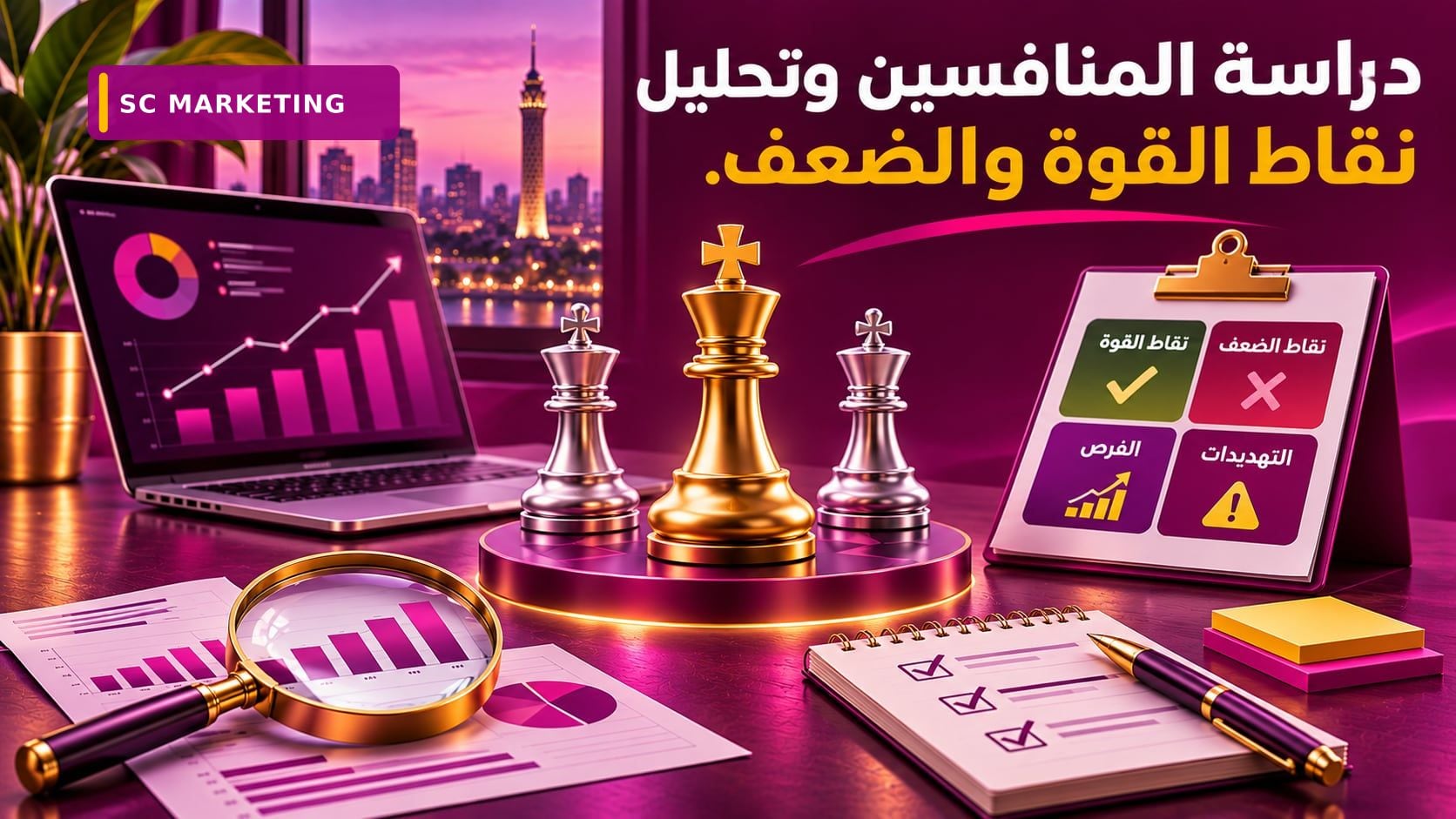


Studying competitors and analyzing their strengths and weaknesses
In increasingly competitive markets and constantly changing customer expectations, providing a good product or service alone is no longer enough to guarantee success. Companies that want to grow and maintain their position need to understand the nature of competition, and know which companies they are targeting customers themselves, and analyze the factors that give each competitor an advantage within the market.
Studying competitors and analyzing their strengths and weaknesses are among the most important consulting and marketing services that help companies evaluate their competitive position, discover business opportunities, and develop more effective strategies to attract customers and increase sales.
Instead of relying on guesswork or imitating competitors' advertising activities, a competitive study provides structured information that helps management understand the reasons for the success of some companies, the factors that influence customer choices, and the points of differentiation that can be developed to build a stronger presence. Inside the market.
Select Customers Marketing, known as SC Marketing, provides the service of studying competitors and analyzing the strengths and weaknesses of companies and commercial, industrial and service projects, through customized analytical solutions aimed at understanding the competitive environment, identifying available opportunities, and supporting decisions. Marketing and commercial.
Through its experience since 2018 in digital marketing, advertising, programming, and developing digital solutions, the company is interested in linking competitive analysis to the actual objectives of projects, and transforming data and observations into recommendations that help companies develop their offers and enhance their position within... Egyptian market.
What is the study of competitors and analysis of strengths and weaknesses?
Competitor Analysis Competitor Analysis is a structured process that aims to collect available information about companies that compete with a particular business, and analyze their products, services, prices, marketing strategies, and sales channels.
This process helps to understand how competitors are positioned within the market, the categories they target, the advantages they rely on to attract customers, and aspects that may represent weak points in their offers or customer experiences.
As for the analysis of strengths and weaknesses, it focuses on evaluating the factors that affect the competitiveness of companies, whether related to product quality, pricing, commercial reputation, distribution, customer service, or marketing and sales efficiency.
When combining competitor analysis with an assessment of the strengths and weaknesses of the company itself, a clearer picture of where the business stands compared to alternatives in the market can be formed.
This does not only mean looking for competitors' shortcomings, but rather includes understanding aspects of their success, identifying practices that can be learned from, and discovering customer needs that are not adequately met by available solutions.
The ultimate goal is to build a real competitive advantage that is difficult to achieve by relying on imitation or reducing prices alone.
The importance of studying competitors for companies in the Egyptian market
Companies in Egypt operate within diverse competitive environments, influenced by the nature of business activity, geographical location, price levels, purchasing power, customer preferences, and the availability of sales and distribution channels.
Organizations may face direct competition from companies that provide the same products, or indirect competition from activities that offer different alternatives that meet similar needs.
The importance of competitive analysis increases when the company is in the process of establishing, expanding, or redeveloping its marketing strategy.
Understand the company's true position within the market
Some companies may believe that they offer the best quality or the most competitive prices, but these impressions need to be systematically compared with existing alternatives.
The study helps evaluate the company's website according to clear criteria, such as the quality of the offer, price, ease of access, purchasing experience, and level of service.
Thus, management becomes more able to know the aspects in which it excels and the aspects that need development.
Discover growth opportunities
Competitor analysis may reveal underserved customer segments, unmet needs, or geographic areas with limited options.
It may also highlight opportunities to develop new products or improve the way services are provided.
Improving marketing decisions
Studying competition helps understand the messages competitors use, the channels they rely on, and the way they present the benefits of products and services.
This information can be used to develop a distinct marketing strategy linked to actual customer needs.
Support pricing decisions
Analyzing prices and trade offers provides a deeper understanding of competition levels and the value customers get for the money they pay.
It also helps to evaluate the suitability of the current price policy without drifting into ill-considered cuts.
Reduce expansion risks
Before entering a new market, launching a product or opening a branch, the study helps assess existing competition and potential barriers, which supports more risk-aware decisions.
The difference between direct and indirect competitors
One of the most important steps in competitive analysis is identifying competitors correctly, because focusing on companies that only offer the same product may lead to ignoring alternatives that influence customer decisions.
Direct competitors
They are companies that provide similar products or services and target the same or similar categories within the market.
For example, two companies that manufacture and sell home furniture and target the same price segment can be considered direct competitors.
The comparison between them is related to factors such as the quality of materials, designs, prices, warranty, and delivery and installation services.
Indirect competitors
They are companies that offer different solutions that can fulfill the same basic need of the customer.
In the furniture sector, ready-made products may compete with custom furniture manufacturing services, although the way the solution is delivered differs.
In the software sector, off-the-shelf solutions may compete with custom applications when the customer is able to achieve their goal using either.
Potential competitors
This category includes companies that may enter the market in the future or expand from an adjacent sector to the activity under study.
The emergence of a new competitor with a different distribution style or innovative pricing model may pose a challenge to existing companies.
Alternative products and services
The competitor may not be a similar organization in appearance, but a product or service that achieves the desired result for the customer in a different way.
Understanding the alternatives is important when assessing the degree of competition, because it helps determine the real options available to the customer.
How are a company's real competitors identified?
A professional competitor study does not begin by collecting the largest possible number of company names, but rather by defining clear criteria for selecting the most influential competitors in the activity.
These criteria include the nature of products and services, target groups, geographical scope, price level, sales channels, and the nature of customer needs.
The list of competitors may vary depending on the region in which the company operates.
For example, a local service company in Cairo may face different competition than a company providing the same service within Alexandria or one of the governorates of Upper Egypt.
Competition may also differ between companies targeting the final consumer and those that sell wholesale or deal with institutions.
Competitors should therefore be classified according to their relevance to the business, identifying primary competitors that deserve detailed analysis, and secondary competitors for which a focused review is sufficient.
This classification prevents wasting time and resources on companies that do not significantly influence the decisions of the target audience.
What aspects does the study of competitors include?
The details of the study vary depending on the nature of the project, but an integrated competitive analysis may include a set of basic axes.
Analysis of products and services
Comparison begins with studying what each competitor offers, including types of products and services, specifications, benefits, and the way solutions are provided to customers.
The diversity of offers, clarity of details, level of specialization, and differences between price categories are evaluated.
Additional services can also be considered, such as warranty, maintenance, installation, technical support, and after-sales service.
The goal is to understand the value the customer receives, not just compare product names or numbers.
Analysis of prices and commercial offers
Advertised prices, discount policies, packages, payment terms and available promotions are studied.
It is important that comparisons be between products or services that are similar in specifications, size, quality, and terms of supply.
A competitor may appear to be less expensive, but offers different specifications or fewer additional services.
A distinction must also be made between the advertised price and the final price when there are additional costs, such as shipping, installation, taxes, or optional services.
Not all competitors' final prices may be considered known if they are based on private negotiation or unpublished quotations.
Brand identity and positioning analysis
This axis includes studying the way each competitor presents himself to the public.
Does it focus on quality? Or prices? Or luxury? Or speed of implementation? Or specialization? Or ease of use?
The visual identity, the way marketing messages are written, the way products and services are presented, and the consistency of communication across different channels are also analysed.
This information helps discover spaces where the company can build a more differentiated mental position.
Social media analysis
The analysis may include reviewing competitor pages on Facebook, Instagram, TikTok, YouTube and LinkedIn depending on the nature of the activity.
The types of content, frequency of publication, presentation of products, interaction methods, advertising offers, and messages used to attract customers are studied.
The nature of videos, designs, educational and sales content can also be evaluated.
It is important not to consider the number of followers or likes as sufficient evidence of a competitor's commercial success.
A page may have a large number of followers, but the general data does not reflect the volume of sales or the quality of customers.
Therefore, the indicators shown should be interpreted as part of the analysis, and not a complete picture of trading performance.
Analysis of competitors' advertising campaigns
Publicly available advertising messages and materials, types of offers, and the way customers are directed to websites or social media can be studied.
This review helps to understand the marketing angles that competitors use, and the products or services that they focus on in their paid communication.
But you can't know a competitor's exact budgets, conversion results, or internal profits just by watching their ads.
This is why confirmed information must be separated from conclusions based on general indicators.
Website and user experience analysis
The website is an important element in evaluating the digital presence of competitors.
The study includes ease of browsing, organization of pages, clarity of services, mobile user experience, communication methods, and ease of access to information.
Site speed and technical performance indicators can also be reviewed using appropriate tools.
For online stores, the study may include the organization of sections, product pages, clarity of prices, shipping and payment options, and ease of completing the order.
This analysis helps discover opportunities to improve the customer experience and increase the efficiency of the company’s website.
Competitor analysis in search engines (SEO).
Search engine competition analysis includes determining which sites appear to customers when searching for products or services related to the activity.
Keywords, types of ranking pages, content quality, site structure, internal links, and appearance in local search results are studied.
Keyword gaps can also be analyzed to find out which search topics competitors appear in while the company's website does not have an appropriate presence.
It is important to distinguish between a commercial competitor and a competitor in search results, because the site that competes for a keyword may be an information platform or a commercial directory and not a company that sells the product itself.
This study helps develop an SEO strategy targeting searches relevant to potential customers.
Analyze customer opinions and competitors' reputation
Public ratings and reviews available on appropriate platforms can be leveraged to understand what aspects customers value and what issues occur most frequently in their experiences.
Feedback may relate to product quality, timeliness, customer service, pricing, or ease of communication.
However, reviews should be treated with caution, as they may not represent all customers, and may include individual experiences or unverifiable opinions.
Unsubstantiated accusations or complaints should not be turned into final rulings on competitors.
It is better to look for recurring patterns supported by multiple pieces of information, and then use the results to identify areas where the company can improve.
Analysis of sales and distribution channels
The strength of competitors varies according to their ability to reach customers.
One competitor may rely on physical branches, while another focuses on e-commerce, resellers, or direct sales teams.
The study includes an evaluation of advertised channels, ease of access to products and services, geographic coverage, and available supply conditions.
It is also possible to study the points of contact with customers, and the clarity of inquiry and ordering procedures.
This information helps identify opportunities through which the distribution network can be developed or the selling experience can be improved.
What is a SWOT analysis of competitors?
SWOT analysis is one of the most popular tools used in strategic planning and assessing competitive positioning.
It depends on four main elements: Strengths, Weaknesses, Opportunities, and Threats.
Although it can be used to study competitors, it is mainly used to evaluate the position of the company itself in the context of the environment within which it operates.
This is why it is preferable to prepare an analysis of the target company, using available information about competitors to understand the factors that affect its competitive position.
Strengths
Includes internal advantages that give the company an advantage when competing.
It may be product quality, brand strength, team experience, business relationships, distribution efficiency, or the ability to provide specialized services.
A feature is not considered a real strength just because the company describes it, but rather its impact and its relevance to customer needs must be evaluated.
Weaknesses
Includes internal aspects that reduce competitiveness or need to be developed.
It may be represented by a weak digital presence, limited distribution channels, slow response to customers, lack of clarity in services, or high operational costs.
Identification of vulnerabilities should be based on verifiable information as much as possible, not on assumptions or personal impressions.
Opportunities
It refers to external factors that the company can benefit from.
They may include the emergence of new needs, the presence of underserved segments, the development of a suitable sales channel, or the ability to reach new geographic areas.
Opportunities need a commercial evaluation to ensure their suitability to the company's capabilities and resources.
Threats
Includes external factors that can negatively affect performance.
It may include increased competition, the emergence of new alternatives, changing supply costs, changing customer preferences, or the entry of companies with strong competitive capabilities.
Identifying these threats helps you develop plans to deal with them before they turn into bigger problems.
The difference between strengths, opportunities, weaknesses and threats
A frequent mistake in preparing a SWOT analysis is mixing internal and external factors.
Strengths and weaknesses relate to the company's characteristics, capabilities and internal resources.
Opportunities and threats relate to factors outside the company that can affect its activity.
For example, having a sales team with relevant experience is an internal strength.
Increased demand for a category of products offered by the company may represent an external opportunity.
Likewise, poor website organization is an internal weakness, while the entry of a new competitor into the market may represent an external threat.
This distinction helps build a more precise analysis and then determine the appropriate actions for each type of factor.
How to turn SWOT analysis into practical decisions
The value of a SWOT analysis is not achieved by simply preparing a table that includes strengths, weaknesses, opportunities and threats.
Rather, its usefulness appears when its results are used to determine appropriate strategic options.
The TOWS matrix can be used to link these elements together.
When a company has a strength that matches an available opportunity, an initiative can be developed that exploits this advantage to reach a new market or segment.
When there is a weakness that prevents taking advantage of an important opportunity, priority can be given to addressing this point.
If the company faces a threat that affects one of its weak areas, it may need to take defensive measures that reduce the risks.
This method helps transform the analysis from a description of the current situation into recommendations linked to goals and resources.
Competitive analysis using Porter's five forces model
One of the tools that can be used to study competition is Porter's Five Forces model.
It is used to understand the nature of competition within the sector and the factors that affect its attractiveness and potential profitability.
The first force: the intensity of competition between existing companies
It relates to the number of competitors, the nature of competition between them, the extent of similarity of products and services, and the difficulty of differentiation.
The second force: the threat of the entry of new competitors
It relates to the ease with which new firms can enter the market, and the barriers associated with capital, technology, distribution and reputation.
The third force: customer negotiating power
This factor becomes increasingly important when customers have many options or a great ability to compare and negotiate.
Fourth force: bargaining power of suppliers
It relates to the extent to which companies depend on specific suppliers, and their ability to influence prices or terms of supply.
Fifth force: the threat of substitute products
It shows how customers can move to different solutions that meet their basic needs.
This model helps to understand competition as a broader system than simply comparing companies in the market.
Benchmarking between the company and competitors
Benchmarking is used to evaluate a company's performance or the characteristics of its offerings compared to specific competitors according to consistent criteria.
Comparison may include product quality, pricing, ease of use, speed of response, variety of services, digital presence, and clarity of sales terms.
For comparison to be useful, it must be based on specific, assessable criteria.
Instead of describing a competitor's site as better, you can evaluate obvious elements such as page loading speed, clarity of communication, organization of content, and ease of placing an order.
It is also possible to prepare a comparison matrix that shows the relative performance of each company according to the available standards.
If evaluation scores are used, the method of calculating them and the sources of information must be explained, and the estimated results should not be presented as confirmed objective measurements.
Benchmarking helps identify the gaps that most impact the customer experience and the company's ability to compete.
How is true competitive advantage discovered?
Competitive advantage is not just a marketing phrase a company uses in advertisements.
Rather, it is an actual value that makes its offer more suitable for a specific category of customers compared to alternatives.
The advantage may be related to specialization in a particular sector, product quality, implementation efficiency, after-sales services, speed of response, or flexibility in meeting needs.
Studying competitors helps test the extent of this feature.
When all companies advertise that they provide the highest quality and best service, these messages become less distinguishable unless linked to real-world evidence and experience.
Therefore, it should be evaluated whether the feature is important to customers, demonstrable, capable of supporting a purchase decision, and relatively difficult to imitate.
It is also necessary to ensure that the company is able to deliver them on a regular basis, so that the marketing promises are consistent with the actual experience.
Analysis of competitors in the Egyptian market according to geographical location
The competitive landscape in Egypt varies from one region to another according to the nature of activity, customers and distribution channels.
Therefore, studying competitors may need to define a clear geographical scope instead of dealing with the Egyptian market as a homogeneous environment.
Study competitors in Cairo
The study may include companies targeting customers in specific areas within Cairo, analyzing the nature of competition, services, prices, digital presence, and channels to reach the audience.
Areas relevant to the activity must be identified, because competition in commercial markets, residential areas or business sectors may differ significantly.
Study of competitors in Giza
The study could focus on competitors serving the same geographic scope, assessing the nature of offerings, price levels and means of reaching customers.
Competition varies according to the nature of the product or service and the extent of the company's ability to operate in multiple regions.
Study of competitors in Alexandria
Some activities may require studying the impact of geographical location, seasonality, and the nature of commercial, industrial, or service demand.
Competitors are selected according to the target sector rather than assuming that there is a single competition pattern for all activities.
Study of competitors in the Delta and Upper Egypt
Companies wishing to expand to the Delta or Upper Egypt governorates need to understand local competitors, distribution methods, and the nature of customers.
The importance of reputation, business relationships and geographical spread may vary from one sector to another.
The local study helps to evaluate these factors more accurately before making expansion decisions.
Study of competitors for electronic stores in Egypt
Online stores face competition related to products, prices, offers, purchasing experience, speed of delivery, and brand trust.
Therefore, the study includes evaluating competing stores in terms of product variety, department classification, information displayed, images, and announced shipping, exchange, and return policies.
Product pages, mobile user experience, and clarity of order completion steps can also be analysed.
The marketing study includes reviewing presence in search engines, visible advertising content, and methods of displaying offers and features.
It is important to evaluate the difference between price competition and value competition.
A store may be able to provide a better experience despite not having the lowest price, by improving information, customer service, and sales and delivery policies.
Study of competitors for factories and industrial companies
Industrial companies need a different type of competitive analysis, because purchasing decisions may depend on technical specifications, production capabilities, reliability, and supply terms.
The study may include identifying alternative factories and suppliers, analyzing announced products and specifications, and evaluating available price levels, distribution channels, and markets served by competitors.
Points of excellence in services related to supply can also be studied, such as the possibility of providing different quantities or implementing special specifications, when reliable information is available to support this.
The results help determine which commercial and industrial sectors the company can target more effectively.
It is important not to assume knowledge of competitors' production costs, actual capacity, or profit margins if reliable data is not available.
Study competitors of service companies
Competition between service companies depends on a set of factors that go beyond price, such as experience, specialization, clarity of scope of work, ease of communication, and quality of implementation.
The study may include contracting companies, engineering services, programming, consulting, marketing and other activities.
The announced services, the method of providing them, target groups, published business models, marketing messages, and available contract terms are reviewed.
The ease of requesting a quote and the nature of the information provided by websites to customers can also be evaluated.
These results help develop the way services are presented, highlight the true aspects of excellence, and build a clearer experience for the potential customer.
Study competitors before launching a new project
Some entrepreneurs may enter markets that appear attractive because of a large number of customers or high apparent demand, without assessing the level of competition and the difficulty of reaching customers.
A competitive study before launching the project helps to understand the existing alternatives, determine the level of saturation, and know the criteria that customers use to compare.
It also shows the opportunities that the new project can rely on to excel.
The result may be that the market is suitable for entry, or that the project needs to adjust its offer, or that a specific segment is more attractive than broad targeting.
In some cases, the study may uncover challenges that make postponing the launch or re-evaluating the business model an option worth considering.
The goal is not to prove the idea's success in advance, but rather to evaluate it more objectively.
Study competitors before launching a new product
Competition analysis helps identify alternative products, available features, price levels, and points of differentiation focused on by existing suppliers.
General customer comments and needs that are not adequately met by existing products can also be studied.
The results help develop a vision for the new product in terms of characteristics, specifications, pricing and marketing messages.
But the extent of customer interest in the product must be tested independently, because the presence of weakness in competitors' offers does not automatically mean the presence of profitable demand for the proposed alternative.
It is best to link competitive analysis with customer studies and practical tests when investment decisions are significant.
How does studying competitors help improve marketing strategy?
The study contributes to developing the marketing strategy by clarifying the company's position within the market and the factors that influence customers' choice.
By knowing the common messages of competitors, it is possible to search for marketing angles that are more distinctive and related to the actual value provided by the company.
Reviewing digital channels also helps discover opportunities to develop the website, improve content, and reach appropriate segments.
The study may reveal keywords related to the service that are not adequately covered by the company's website, or important questions asked by customers that are not addressed in current marketing materials.
Comparison results can also be used to improve commercial offers and clarify the advantages worth emphasizing during sales.
Studying competitors should not lead to copying their campaigns or designs, but rather to understanding the market and developing independent decisions that fit the company's identity and goals.
The importance of analyzing competitors' weaknesses without relying on imitation
Some companies may make the mistake of focusing on competitors' weaknesses as a direct opportunity to attack them in advertising.
But the most effective approach in the long run is to use this information to develop the product or service and improve the customer experience.
If available data shows that customers care about speed of communication, the company can evaluate its ability to develop a more efficient follow-up system.
If the audience needs clearer information before purchasing, the services and products pages can be improved and provide details that help in decision-making.
However, if the comparison indicates a weakness in the options suitable for a particular segment, the possibility of providing a specialized offer that serves its needs can be studied.
This approach helps build a positive competitive advantage based on improving the value provided rather than defaming competitors or providing unsubstantiated comparisons.
How to prepare a professional report to analyze competitors
The report preparation process begins by defining the objective of the study, the target market, and the competitors who will be evaluated.
The comparison criteria, data sources, and method of documenting information are then determined.
The next stage includes collecting and verifying general data, then organizing the results into clear axes.
The report may include an introduction to main competitors, analysis of products and services, comparison of available prices, assessment of digital presence, analysis of marketing messages, strengths and weaknesses.
It is also possible to prepare a competitive comparison matrix and evaluate the company's SWOT in light of the study results.
An important element of the report is clarifying the source of each key piece of information and the date it was collected, especially in aspects that change quickly, such as prices, offers, and campaigns.
The report must include practical conclusions that show where the company has opportunities for improvement, what risks are worth pursuing, and what initiatives are proposed in order of priority.
The outputs could include an initial roadmap for developing the aspects that most impact competitiveness, depending on the scope of the contract.
Stages of implementing the competitor study service and analyzing their strengths and weaknesses
Systematic study requires a set of integrated stages.
The first stage: understanding the company's activity
The process begins by defining the nature of the products or services, target audience, business objectives, and markets within which the company operates.
The second stage: identifying competitors
A list of direct and indirect competitors and relevant substitutes is prepared, then the most important companies are selected for analysis.
The third stage: determining comparison standards
Criteria that actually relate to customer decisions are selected, such as quality, pricing, specialization, distribution, digital presence and purchasing experience.
The fourth stage: collecting information
Data is collected from legitimately available sources, such as competitors' official websites, public pages, published commercial information, and appropriate analysis tools.
The fifth stage: data verification
Information is reviewed and distinctions are made between direct facts, estimates and impressions, identifying statements that cannot be verified.
Sixth stage: Conduct competitive analysis
Companies are compared according to specified criteria, and differences, points of distinction and potential gaps are extracted.
Seventh stage: SWOT analysis
The company's internal strengths and weaknesses are evaluated in light of competition, while external opportunities and threats are identified.
The eighth stage: preparing recommendations
The results are ranked according to their importance and potential impact, and identify actions that can help the company develop its competitive position.
The ninth stage: reviewing and updating the results
The study can be updated when new competitors emerge, prices change, new products are launched, or significant changes occur in the market.
The details of these stages vary depending on the scope of the study and the data required.
What tools are used in competitor analysis?
There are digital tools that can be used to study specific aspects of competition, especially competition related to websites, search engines, and digital advertising.
The most prominent of these are Google Search to review search results related to products and services, Google Trends to study indicators of relative interest in search topics, and keyword analysis tools and sites such as Semrush and Ahrefs according to subscriptions and available data.
Meta Ad Library can also be used to view general advertising information available as provided by the platform, and web page performance measurement tools to review some technical aspects.
Competitors' websites and official pages are useful in collecting information about products, services, offers, and announced prices.
However, estimates of visits, keywords, and advertising data must be treated as indicators whose accuracy varies depending on the tool and the nature of the site.
No third-party tool can provide all of a competitor's internal business data with certainty.
When does a company need to re-examine competitors?
Competitive analysis is not an activity that should be done once and then ignored for years.
Markets change, companies develop their offerings, and new competition may emerge that affects customer choices.
Re-examination becomes important when new competitors enter, price levels change, alternative products are launched, sales decline, or the conversion rate of potential customers decreases.
It is also preferable to update the analysis before geographical expansion, launching an important product, or changing the pricing and positioning strategy.
A brief periodic follow-up of rapidly changing indicators can be carried out, with a deeper analytical review when needed.
There is no fixed period that is suitable for all companies, as the appropriate pace of modernization varies depending on the speed of sector change, the level of competition, and available resources.
Common mistakes when studying competitors
The most common mistakes are relying on personal impressions instead of data, or choosing competitors based only on their reputation without ensuring that they are targeting the same customers.
Some companies also make the mistake of comparing prices without taking into account the difference in specifications and services, or considering the number of followers as a direct measure of sales.
It is also a mistake to use outdated data, overestimate the size of a competitor, or assume knowledge of its internal profits and budgets without evidence.
Excessive focus on competitors may also lead to neglecting customers and their actual needs.
A company may succeed in imitating a product or advertising campaign without providing a real reason for customers to choose it.
It is also important not to confuse internal weaknesses with external threats when preparing a SWOT analysis.
The effectiveness of the study increases when it relies on reliable information, clear standards, and recommendations that are linked to the company’s capabilities and goals.
How much does it cost to study competitors and analyze their strengths and weaknesses in Egypt?
Prices for studying competitors in Egypt vary according to the size of the business activity, the nature of the sector, the number of competitors, the level of analysis required, and the target markets and geographic regions.
A study that deals with a limited group of local competitors differs in its requirements from analyzing a sector that includes multiple companies operating across several governorates and sales channels.
The cost is also affected by the type of topics to be studied.
One client may need to compare products, prices, and marketing messages, while another client needs a comprehensive analysis that includes websites, search engines, advertising, competitive positioning, and customer experience.
Factors affecting the price also include the availability of data, the need for additional research, the degree of detail of the report, and the type of outputs and recommendations required.
The cost of studying competitors as an independent service may differ from the cost of building a marketing strategy or implementing advertising campaigns depending on its results.
SC Marketing offers customized solutions at competitive prices, with the scope of work determined according to the project requirements and the nature of the target market.
An appropriate price quote can be obtained after clarifying the nature of the activity, the objectives of the study, the number of competitors expected to be analyzed, and the required outputs.
How do you choose a company that specializes in studying competitors?
When searching for a competitor analysis company in Egypt, it is important to evaluate its ability to understand your business, and not just collect the names of competing companies or display pictures of their websites and pages.
The study must rely on a clear methodology, appropriate sources of information, and interpretable comparative standards.
The results should also be linked to the company's needs and goals, and show where it has competitive advantages and what aspects need to be developed.
It is important to agree in advance on the scope of the study, the number of competitors, the topics that will be analyzed, the type of report, and the method for presenting recommendations.
The value of the service increases when it helps management make specific decisions, rather than providing general information without explanation or priorities.
Why choose SC Marketing to study competitors and analyze their strengths and weaknesses?
The study of competition requires an integrated understanding of the relationship between the market, customers, marketing, sales and technology.
Since 2018, Select Customers Marketing has been working in the areas of advertising, digital marketing, programming and digital solutions development, giving it a multidisciplinary background when tackling marketing and business challenges.
The company is interested in understanding the nature of each project before determining the appropriate scope of analysis, with a focus on studying the factors that affect the activity’s ability to compete.
It also seeks to provide customized solutions that take into account the nature of the target market, the client's needs, and the available budget.
The aspects that the service focuses on include understanding the company's position, analyzing competing alternatives, evaluating opportunities for differentiation, and determining priorities that deserve development.
The goal of studying competitors remains to support business and marketing decisions with structured information and analysis, and not merely to prepare a descriptive report on other companies.
Study competitors in Arab markets
Although the Egyptian market represents the priority for this article, companies may need to study their competitors in other Arab markets, especially when planning expansion, exports, or providing online services.
Target markets for Select Customers Marketing services include Egypt, Saudi Arabia, UAE, Jordan, Iraq, Oman, Kuwait, Qatar and Sudan.
Competition varies between these countries according to the nature of the sector, price levels, customer characteristics, distribution channels, and economic and regulatory conditions.
Therefore, competitors must be identified and the business environment analyzed independently for each market.
A company that has a strong competitive position within Egypt may face completely different competitors when entering a foreign market.
A dedicated study helps to understand these differences and evaluate expansion opportunities more realistically.
Frequently asked questions about studying competitors and analyzing their strengths and weaknesses
What is competitor analysis?
It is the process of collecting and analyzing available information about companies that provide similar or alternative products or services, with the aim of understanding their position in the market, their strategies, points of distinction, and aspects that may need development.
Why is it important to study competitors before starting a new project?
The study helps to determine the alternatives available to customers, understand the level of competition, evaluate prices and offers, and discover opportunities for differentiation before allocating large budgets to the project.
What is the difference between competitor analysis and SWOT analysis?
Competitor analysis focuses on competing companies and alternatives within a market, while SWOT is used to evaluate a company's internal strengths and weaknesses and the external opportunities and threats surrounding it. The results of competitor analysis can be used as an important input for preparing SWOT.
Is it possible to study competitors only online?
Digital analysis can be conducted based on public sources, websites, communication platforms, and research tools. But some decisions may need additional information about customers, distribution or purchasing experience that digital sources alone cannot provide.
How many competitors should be analysed?
There is no fixed number that fits all activities. The choice depends on the size of the market, the nature of the sector and the purpose of the study, with priority given to competitors that most influence the target audience's decisions.
Is it possible to know competitors' advertising budgets?
Some platforms may provide general information or specific scopes for some ad types, but exact budgets and internal conversion results are usually not fully available. Therefore, presenting unsubstantiated estimates as facts should be avoided.
Does studying competitors help determine product prices?
Yes, it can provide information about advertised prices, offers and associated benefits. But setting the right price also requires studying costs, profit margins, and the value the customer receives.
Is competitor analysis suitable for small businesses?
Yes, a specific study can be prepared that focuses on the most prominent competitors and the factors that most influence the company’s activity, in proportion to the available resources.
Is it possible to analyze competitors in the different governorates of Egypt?
Yes, and the scope of the study can be determined in Cairo, Giza, Alexandria, or other governorates, according to the regions in which the company operates or plans to expand to.
Does the study include competitors on Google?
It can include analyzing competition in search results, keywords, content, and pages that appear to customers, if this axis is within the agreed upon scope of service.
How do I know my company's weaknesses compared to competitors?
This is done by setting benchmarks related to customer experience and value provided, then evaluating internal performance and available information about competing alternatives.
Can competitor analysis be used to improve advertising?
Yes, it helps to understand popular messages and offers, discover different marketing angles, and develop content that highlights the company’s true advantages.
Does the study include analysis of social media pages?
It can include reviewing content, communication, offers, level of activity and general indicators available, while avoiding assuming that apparent engagement reflects actual sales.
What is the difference between studying competitors and studying the market?
Competitor study focuses on companies and substitutes within the market, while market study includes a broader scope that addresses demand, customer behavior, prices, distribution, opportunities, and economic and business factors.
Does studying competitors reveal new business opportunities?
It may help discover underserved segments, gaps in products and services, or opportunities for expansion. But these opportunities must be evaluated in terms of demand, costs and ability to implement before investing.
Is it possible to re-examine competitors after changing the marketing strategy?
Yes, re-evaluation may even be useful to know the extent to which the company's competitive position has changed, and to discover new challenges and opportunities.
What information is required to start studying competitors?
It is helpful to provide an overview of the business, products and services, target audience, geographic regions and company objectives, along with the names of any known competitors if available.
Does studying competitors guarantee increased sales?
The study does not guarantee specific business results, because sales are affected by product quality, pricing, fulfillment, competition and other factors. But it helps improve the quality of decisions and identify development opportunities.
How can I obtain a competitor study service from SC Marketing?
You can contact the company through its official website, and clarify the nature of the activity, the objectives of the study, and known competitors, so that the scope of the appropriate analysis is determined and the outputs and costs are discussed.
Know your competitors, identify your strengths, and build a real competitive advantage
Success in the market does not depend only on knowing what your company does, but it also requires understanding the alternatives available to your customers, the factors that influence their decisions, and the advantages that can give your activity a distinguished position.
Studying competitors and analyzing their strengths and weaknesses helps move from decisions based on impressions to a clearer view of the competitive landscape.
By analyzing competing companies, evaluating products, services, prices, and marketing channels, and studying strengths, weaknesses, opportunities, and threats, companies can develop their offers, improve competition methods, and determine growth priorities.
Whether you are running an existing company, launching a new project, planning expansion, or want to redevelop your marketing strategy, a structured competitive analysis is an important step in understanding your current position and opportunities that can be worked on.
Select Customers Marketing provides the service of studying competitors and analyzing the strengths and weaknesses of companies and projects in Egypt, with an interest in providing customized solutions and analyzes related to the needs of each activity.
Contact the SC Marketing team to discuss your company goals, learn about the appropriate scope of the study, and obtain a quote for a competitor analysis service.
Official website:
https://selectcustomersmarketing.com/
SC Marketing — Understand your competitors, discover your differentiators, and develop your marketing decisions with confidence.