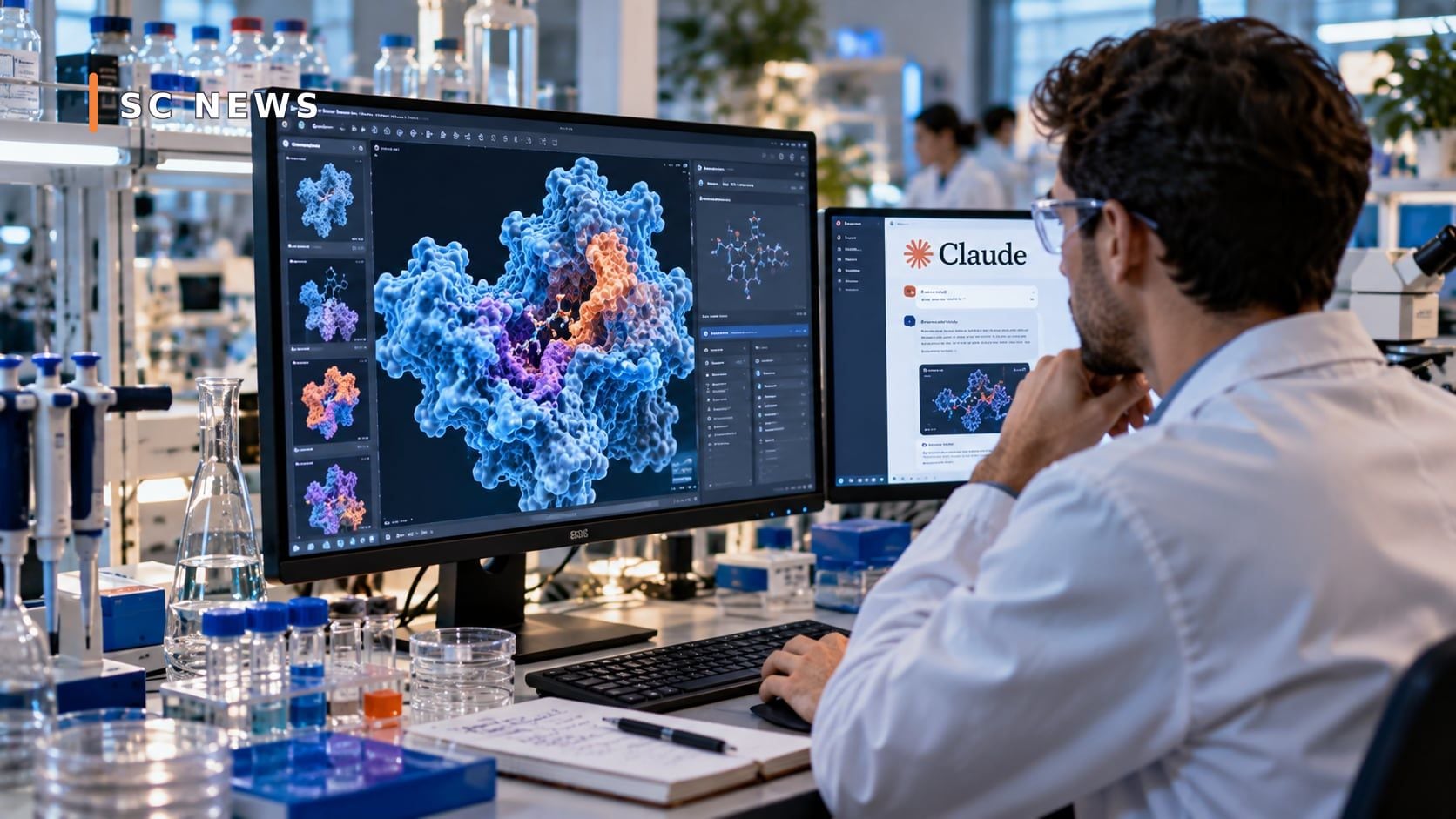
Anthropic has revealed initial progress on projects employing Claude's model to accelerate drug discovery research, announcing its collaboration with six organizations working in the biotechnology and pharmaceutical industries.
The announcement came in a research report issued by the company on October 27, 2026, which reviewed how to use Artificial intelligence in designing therapeutic molecules, analyzing laboratory results, and improving drug development steps.
Anthropic stressed that most of these efforts are still in the pre-clinical trial stages, and that the current results do not mean proving the effectiveness of any new treatment in humans.
Anthropic+1
Six Research partnerships in various fields
Anthropic's collaborators include BigHat Biosciences, Bristol Myers Squibb, Divergence Labs, Enveda, Generate Biomedicines, and The Column Group.
These agencies work at different stages of drug development, from molecular research and protein design, to... Evaluating the chances of success of some treatment programs.
Through these partnerships, Anthropic seeks to test how Claude can help researchers with complex scientific and operational tasks, not just answer general medical questions.
Preliminary results in antibody development
Sunday The most prominent example revealed by the company is related to its cooperation with BigHat Biosciences to improve the properties of antibodies that can be used in developing future treatments.
Over the course of about ten weeks, the researchers tested approximately 1,010 laboratory variables, after using Claude to help suggest modifications and analyze Results.
The company reported that some of the best investigated variants showed more than a tenfold improvement in target binding strength compared to the original designs, along with improvements in the physical stability of some molecules.
وتعد هذه النتائج مهمة في مرحلة تطوير المرشحات therapeutic, but it does not prove that the molecules will be safe or effective in patients.
Claude enters the clinical trial planning phase
The collaboration has also extended to Bristol Myers Squibb, which is using Claude to help study plans for early clinical trials and analyze options for developing pharmaceutical.
These uses allow researchers to review large sets of information, examine scientific assumptions, and prepare preliminary analyzes that can be developed under expert supervision.
The two companies plan to expand this cooperation during 2027 with the aim of testing its role in improving decisions related to pharmaceutical programs.
It is important here to distinguish between the model's assistance in preparing the analysis and making the final medical decision. Responsibility for clinical trials and verification of drug safety remains with specialists and regulatory authorities.
Acquisition of Mithril Medicine
Anthropic revealed Also announced is the acquisition of Mithril Medicine, a small startup focused on research into rare muscle diseases in children.
The company's founder employed Claude to help manage multiple research and operational aspects, including coordinating work with external laboratories.
Anthropic reported results An encouraging preliminary in experiments on mice for a research program.
If results continue in the desired direction, the company aims to reach early human trials for some therapeutic candidates as of late 2028, stressing that this is a conditional research goal and not a guaranteed date.
What What characterizes the use of artificial intelligence in drug development?
The drug development process typically takes multiple stages that include biological target discovery, molecule design, laboratory testing, clinical trials, and regulatory reviews.
Anthropic is trying to employ Claude at more than one stage These stages rather than limiting its role to proposing new molecules.
One potential benefit may be to speed up the analysis of information, coordinate experiments, and reduce the time spent on some research work.
But the presence of a model capable of proposing new hypotheses does not mean that these hypotheses are correct automatically.
That's why actual trials, independent verification and clinical testing remain necessary to evaluate results.
What's next?
Anthropic intends to expand its research partnerships, develop Claude Science tools, and deepen the use of models at different stages of the drug discovery process.
And it will be The upcoming findings are even more important when research moves from laboratories to controlled clinical trials.
For now, the announcement reflects the expanding use of AI in applied science, but it does not represent an announcement of an approved treatment for any disease.